sexta-feira, 20 de setembro de 2013

50 Clever Tutorials and Techniques on Traditional Drawing

Traditional drawing is certainly way harder than digital and it is true that people are able to progress much faster digitally, but one should learn the traditional type of drawing and painting before starting digital drawing, since it often lays out the foundation for screen design.
This article contains a mixture of traditional drawing tutorials, drawing techniques and some methods for transforming and preparing your creations for screen design. Some are intermediate level and some are advanced tutorials that include general theory, useful tips, comic inspired art, sketch a pencil drawing, coloring processing, character sketching, shapes, proportional, perspective and much more. We hope that drawing tutorials and techniques in this post will be a great help to you.

Traditional Drawing Tutorials

Marilyn Portrait Tutorial
A truly fantastic drawing tutorial to learn how to draw a portrait of Marilyn Monroe with pencil. Each step of the portrait is perfectly well explained and commented. This tutorial is very detailed, and requires a lot of patience.
Screenshot
Portrait tutorial
This is a step by step tutorial on how to draw a realistic portrait. The artist assumes that you have a basic understanding of drawing and shading before attempting to draw a serious portrait. For this lesson he is drawing on 11″x14″ Fabriano Hotpressed Watercolor Paper. He is using Derwent Graphic Pencils ranging from 2H to 7B. For more information on any of the drawing tools that he mention in this tutorial, visit the drawing materials page.
Screenshot

segunda-feira, 9 de setembro de 2013

More about Drawing

Drawing is a form of visual art that makes use of any number of drawing instruments to mark a two-dimensional medium. Instruments used include graphite pencils, pen and ink, inked brushes, wax color pencils, crayons, charcoal, chalk, pastels, various kinds of erasers, markers, styluses, and various metals (such as silverpoint). An artist who practices or works in drawing may be called a draftsman or draughtsman.[1]
A small amount of material is released onto the two dimensional medium, leaving a visible mark. The most common support for drawing is paper, although other materials, such as cardboard, plastic, leather, canvas, and board, may be used. Temporary drawings may be made on a blackboard or whiteboard or indeed almost anything. The medium has been a popular and fundamental means of public expression throughout human history. It is one of the simplest and most efficient means of communicating visual ideas.[2] The wide availability of drawing instruments makes drawing more common than other media.

sexta-feira, 6 de setembro de 2013

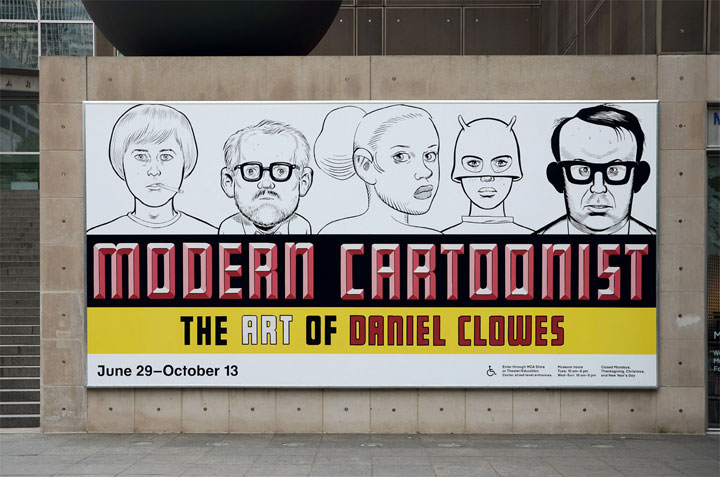
Modern Cartoonist: The Art of Daniel Clowes at MCA Chicago


Exterior of The Museum of Contemporary Art, Chicago. Image courtesy of Berny Tan.

Currently on view at the Museum of Contemporary Art Chicago is Modern Cartoonist: The Art of Daniel Clowes, the very first museum retrospective to survey the work of the acclaimed comic book artist and graphic novelist. The Chicago-born, Oakland-based Clowes is responsible for such cult classics as Like a Velvet Glove Cast in Iron (1993), Ghost World (1997, and its 2001 film adaptation of the same name), David Boring (2000), and The Death-Ray (2011). An expanded version of a 2012 exhibition at the Oakland Museum of California, Modern Cartoonist presents more than 125 original illustrations and artifacts within thoughtfully designed exhibition spaces.


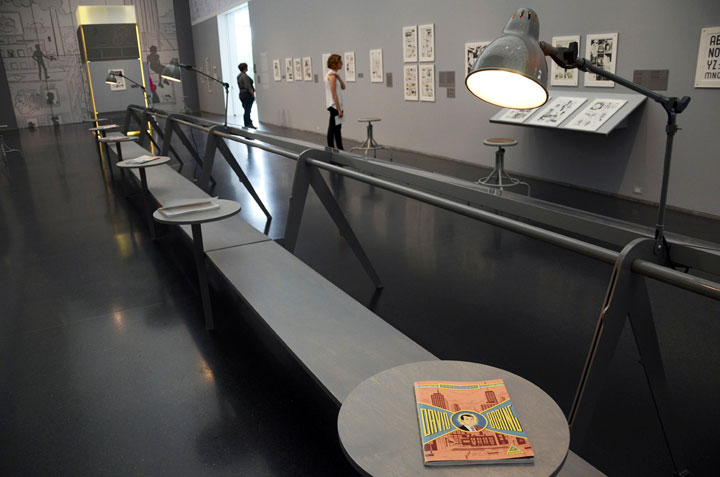
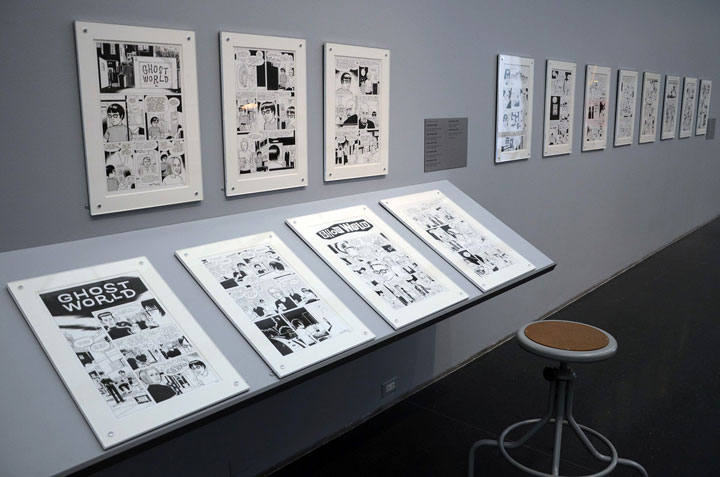
Installation shot of Modern Cartoonist: The Art of Daniel Clowes at The Museum of Contemporary Art, Chicago, August 2013. Image courtesy of Berny Tan.

Installation shot of Modern Cartoonist: The Art of Daniel Clowes at The Museum of Contemporary Art, Chicago, August 2013. Image courtesy of Berny Tan.

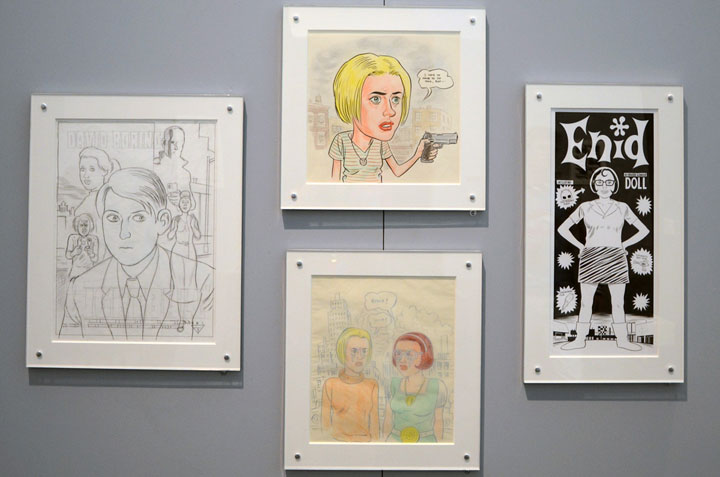
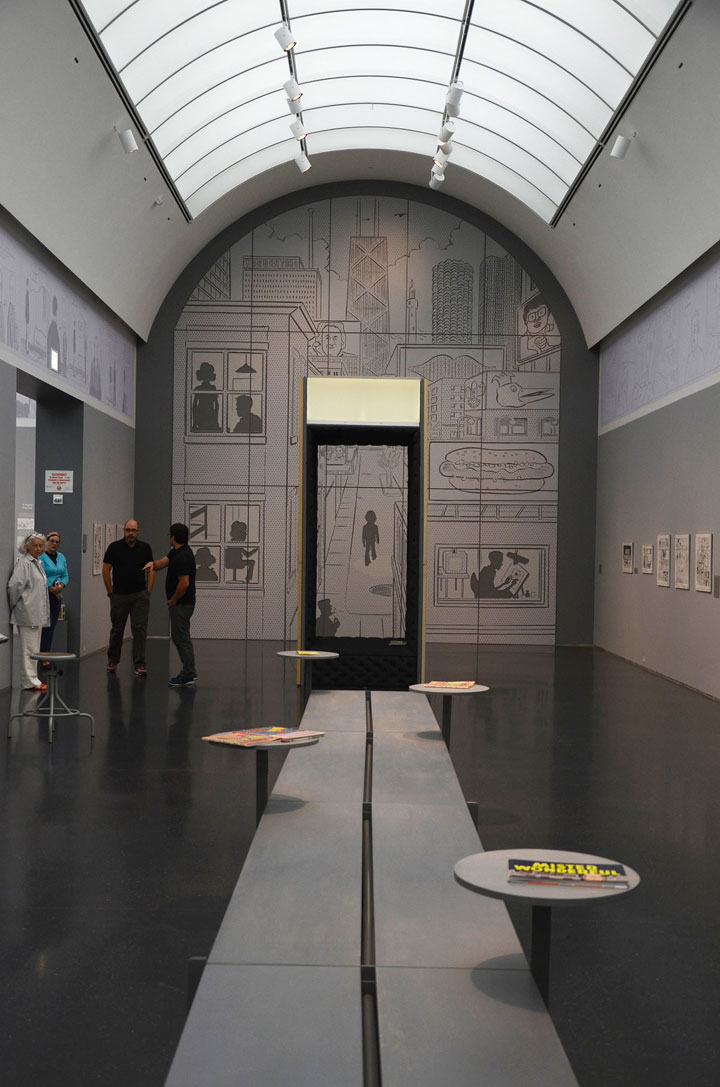
From deftly executed ink and Zipatone drawings to rich, saturated gouache paintings and rough graphite sketches, the works on display well validate Clowes’s abilities as a draftsman. One can imagine an excited Clowes fan devouring the pages upon pages of his illustrations on view in their bare, black-and-white form. For the rest of us, there is something to appreciate in both the meticulous lettering and literary content of each speech bubble. Single-page excerpts from Clowes’s most well-known comics are more than enough to bait the uninitiated into spending time with their bleak and often twisted narratives. In addition, two 20-foot-high monochromatic murals, featuring silhouettes of Clowes’s characters situated within urban Chicago, are pleasant, unexpected bookends to the exhibition’s drawings and publications.


Installation shot of Modern Cartoonist: The Art of Daniel Clowes at The Museum of Contemporary Art, Chicago, August 2013. Image courtesy of Berny Tan.

The exhibition is a joy to experience due not only to the immersive nature of Clowes’s work, but also to the exhibition design of Nicholas de Monchaux, who created a comfortable environment within which illustrations could be appreciated and comics perused. It would have been easy for de Monchaux to succumb to the seductively bright color palette of Clowes’s gouache paintings, or the muted yet diverse tones of his graphic novels. Instead, the designer opts for subtle shades of calming grays for the walls and fixtures. Ample seating is provided in the form of benches (lamps and tables included) and intimate spaces with upholstered seating where one might sit for hours on end reading Clowes’s graphic novels from cover to cover.


Daniel Clowes, Eightball 18 (cover), 1997. Gouache on white board, 24 3/4 x 22 1/2 x 1/2 inches. Collection of Daniel Clowes. Image courtesy of the artist and Oakland Museum of California.


Six decades after the inception of pop art and accompanying discussions of high-art-versus-low-art, today any debate about whether Clowes’s work belongs in a fine art museum should be rendered moot. However, questions regarding if and how we should compare Clowes and his peers to such artists as Roy Lichtenstein still remain, since we can expect both to continue inhabiting museums. Curator of the exhibition Susan Miller has commented on the similarities between Clowes’s style and the flatness of paintings by Alex Katz, as if to legitimize Clowes and the exhibition; the framing and display of Clowes’s illustrations lend a certain fine art regality to his oeuvre.

The issue here goes beyond the tired back-and-forth about whether a cartoonist should be viewed as a ‘fine artist.’ The museum setting inevitably transforms the way that someone might otherwise relate to comics and graphic novels, which require much more time than today’s average museum-goer would accord to an artwork. How does one relate to material that is as much literary as it is visual within an art exhibition? Is the viewer willing to spend hours—in an exhibition space designed with that in mind—not just admiring Clowes’s inking technique, but also the dark and dysfunctional narratives that jar with his deceptively simple aesthetic? How does the art museum do justice to the works’ literary aspects in addition to their aesthetic ones?


Installation shot of Modern Cartoonist: The Art of Daniel Clowes at The Museum of Contemporary Art, Chicago, August 2013. Image courtesy of Berny Tan.

Installation shot of Modern Cartoonist: The Art of Daniel Clowes at The Museum of Contemporary Art, Chicago, August 2013. Image courtesy of Berny Tan.

An exhibition such as Modern Cartoonist, intentionally or not, raises questions about the role of the museum in today’s world and its responsibilities in terms of education, experimentation, and even entertainment. It provides a refreshingly accessible and engaging experience to an audience with a diverse set of approaches, creating conditions that challenge both museum-goers and comics enthusiasts alike to consider Clowes’s work in a new context.

–Berny Tan, Communications Intern

Modern Cartoonist: The Art of Daniel Clowes runs through October 13 at the Museum of Contemporary Art Chicago (220 East Chicago Avenue, Chicago, IL 60611).

sexta-feira, 30 de agosto de 2013

How to Draw a Human Eye on 5 steps

Edited by Maxwell K, Maluniu, ElizabethD, BR and 7 others


Draw a Human Eye
This will teach you how to draw realistic human eyes.

Edit Steps

  1. 1
    Draw one big circular ball to make out the eye. This will form the eye socket. The top of this circle is where the eyebrow is and at the bottom is where the cheek bone sits. Add the lines.
  2. 2
    Draw the eyeball floating in the centre of the socket.
  3. 3
    You then need to work on the shape of the eye. Eyes are almond shaped, so bear this in mind as you sketch them. As a rule of thumb, the distance between the two eyes is the width of another eye.
  4. 4
    Inside the iris, the color inside the center of the eye, draw the pupil which is the darkest bit of the eye. Fill most of it in black and leave a little white. With your pencil flat, use a bit of shading for the base.
  5. 5
    Next, draw the top of the eyelid over the top of the almond. Add any detail you like, like eyelashes, etc.,

sexta-feira, 23 de agosto de 2013

Draw famous faces

So you’re a budding artist, but you need a little help to get going? The good news is that we’re here to help you get your celeb drawing or sketched masterpiece done in no time.
Whether you want to know how to draw Justin Bieber, how to draw One Direction, how to draw Lady Gagahow to draw Nicki Minajhow to draw Rihanna or how to draw a number of other famous faces, we’re gonna help you!

Now you can draw quickly and accurately

We’ve done two important things to help you draw your favorite celebrities QUICKLY and ACCURATELY:
  1. Grid Method: All images come with a ready-made grid to save you time and help you draw your portrait realistically.
  2. Gray-scale Images to Help You Shade: All the photos on this site have been converted to black and white to make it easy for you to match the grays tones when you shade in your drawing.
 Find ready-made grid and gray-scale reference images now to make learning how to draw a portrait of favorite celebrity a quick and easy, step by step process.

segunda-feira, 12 de agosto de 2013

History of Drawing: the textbook

History of Drawing is a textbook and reference book available free to anyone who loves drawings.


Use the navigator at the top of the page to jump between chapters.


Thomas Buser earned his doctorate in Art History from NYU’s Institute of Fine Arts in 1974. He taught courses in Baroque Art and the course History of Prints and Drawings at the University of Louisville until his retirement in 2005. He has published Religious Art in the Nineteenth Century in Europe and America (two volumes, 2002) and the textbook Experiencing Art Around Us (second edition, 2006).


As far as possible, the drawings have been reproduced throughout the book in the same scale: halfway across the page equals 20 centimeters (about eight inches), all the way across the page equals 40 centimeters (a little less than sixteen inches). Needless to say, drawings that are wider than 40 centimeters are out of scale.


segunda-feira, 15 de julho de 2013

Artists call weekend gathering the 'Drawing Frenzy,' invite parents to bring artistic children.

Parents that have kids with artistic flair might want to eat at the Crossroads Coffee House after 11 a.m. some Saturday or Sunday.  Like every weekend for several years, a local group of professional artists will be there. They call it the "Drawing Frenzy," a come one, come all draw-a-thon.
All artists, from children to adults are welcome.  They can ask questions, or talk about their favorite animated show, comic book or whatever inspires their art.  But there are a couple of rules.  Keep the conversation light … no politics.  Just stop in, pull up a sandwich and a pen, tablet, sculpture -- you get the idea.
One creator of the Drawing Frenzy and illustration mentor is Mike Sullivan, a talented local comic-book artist.
"It’s just a very nurturing environment for creativity and people are drawn to it… and we just feed off that,” Sullivan said.
Another local painter and comic artist that meets regularly at the coffee house is Darryl Woods. He tells young artists to draw something every day but make sure it’s something new: Don’t keep rehashing the same old thing.
Woods said he has seen the Drawing Frenzy bring the shy strokes of a budding artist to full bloom. As he tells the tale, just last week a young, shy visitor to the coffee house came in to share a few sketches.  She introduced herself as the daughter of a face painter.
“She had very low confidence in her ability to draw,” Woods said.  “She is an extraordinary artist.”
The gang at the Drawing Frenzy is certainly about encouragement, and that is the message they pass along to each and every person who has the courage to pull up a chair and share their doodles.
The Drawing Frenzy meets at the Crossroads Coffee House, 310 Southwest Blvd., Kansas City, Mo., 64108.  The artists meet from 11 a.m. – 3 p.m. every Saturday and Sunday.
The artists include: Mike Sullivan, Ed Lavallee, Joe Hall, Damont Jordan, Beejay Hawn, Greg Gildersleeve, Taylor Castro, Buck Sommerkamp, Rob Nix and Mike Keener.

terça-feira, 25 de junho de 2013

Political cartoonists invading Salt Lake City

Don’t tell political cartoonist Matt Wuerker that he works in a dying business or that the traditional print form of lampooning is an endangered species.

"There is a shorter and shorter attention span in readership," said the president of the Association of American Editorial Cartoonists. "Nothing addresses that strange problem more than a good political cartoon. The old saw that a picture is worth a thousand words speaks to the unique power of cartoons to communicate complex ideas...It takes less time to get a cartoon than to read 140 characters [on Twitter]."


Wuerker and more than 80 of the nation’s top cartoonists will be in Salt Lake City this week for the association’s annual convention. Those participating include Pulitzer Prize winners such as Wuerker from Politico, Steve Benson from The Arizona Republic and Patrick Oliphant from Universal Uclick Syndicate. The Salt Lake Tribune’s Pat Bagley also will be at the event that includes workshops, a cartoonist "death match" at The Tavernacle Bar and a Cartoons and Cocktails benefit and auction.

Several free workshops open to the public will examine issues such as the use of cartoons to satirize religion, a look at Thomas Nast, who is regarded as the father of modern political cartoons, and how political cartoons often kick-start controversy. (See schedule.)

"We are a strange bunch," said Wuerker. "We represent the full political spectrum with troglodytes on the right and bleeding hearts on the left. But what trumps political differences is respect for each other’s drawing and keeping an ancient and enduring craft alive."

Benson, a Brigham Young University graduate and grandson of former LDS Church President Ezra Taft Benson, said cartoonists look at the world differently.

"Cartoonists tend to see quirky things," he said. "It’s a working combination of being analytical on the current-events side mixed with a deep sense of curiosity about the world in the left side of the brain along with the little kid who never grew up and liked to draw funny pictures in class."

The Arizona Republic cartoonist said his art is about more than drawing. It is about illustrating an opinion on a political, social or current topic.

Though both he and Bagley have retired from the LDS Church, they met at BYU, where they worked as cartoonists for The Daily Universe. Their controversial takes on campus life often caused a stir.

The two published a collection of their Daily Universe cartoons and selected letters to the editor in 1979 in a book called I Am Appalled … (the title, Benson said, refers to the way many BYU students would start their letters to the editor about cartoons that offended them).


For example, Bagley’s first cartoon lampooned BYU’s fight over federal Title IX policies mandating coed housing. He portrayed National Guardsmen bringing in a young woman as a new roommate in previously all-male housing. Benson said students were not angered by the cartoon’s message but the fact that Bagley had placed a poster of bikini-clad Farrah Fawcett on the wall.

"An editorial cartoonist throws the first punch in a bar fight and then sits back and watches everyone fight," said Benson.

Jen Sorensen, a self-syndicated cartoonist whose primary clients are alternative weeklies such as Salt Lake City Weekly, is an example of that. She has found work on Web-oriented sites such as The Daily Kos, NPR.org and Politico. She has also found freelance work in longer-form commissioned comics.


"The print media still forms the foundation for my income, but there are a lot of other little avenues I am pursuing online."

Wuerker said the Internet allows cartoonists to experiment with new forms of the craft, including animation and interactive cartoons.

Benson put how his peers view the new technology in a different way.

"You have those whose job is to educate the cartooning coots, who are still happy with a camel-hair brush and who ask what’s this Photoshop stuff," he said. "The swamp might be being drained, but it’s still there. It’s a smaller pond, but it still has life in it."

sexta-feira, 26 de abril de 2013

Jack McInerney's success drawing national attention


CHESTER, Pa. -- Jack McInerney is leading the MLS in goals, was named the MLS Player of the Week and is pacing the Union to victory.

Now comes the national attention.

“I’ve gotten more text messages and tweets than I’ve ever gotten,” said McInerney, who is coming off a two-goal effort against DC United last Sunday. "It’s been a little bit different, but I won’t say I don’t like it. As long as I’m playing well, I’m happy.”

And so are the Union. At 20-years-old, McInerney is in his fourth year with the club that drafted him fifth overall in the 2010 MLS SuperDraft. And after leading the Union in goals last season with eight in 25 games, McInerney now has six goals in seven games and is the point-man of the Union offense, helping his club to an early 3-2-2 record.

This success, mixed with his flair for the clutch late-game goal, has some calling him the “American Chicharito” or “Jackharito.” But whatever nickname he is handed, McInerney can be called confident.

“I don’t think there’s a ceiling for confidence,” he said, preparing for the New England Revolution on Saturday. “Lately, it’s all been good for me. But I still need to keep my head down and keep playing every week. Next week could be the exact opposite. It gets higher and higher every single day and as long as we’re playing well and winning games, it’s good for the team.”

With his early-season success, the national media has heaped praise on the young star, even demanding McInerney receive attention from the US Men’s National Team. But with attention comes expectation, which has caused coach John Hackworth to try and keep McInerney from buckling under the pressure.

“I think Jack is going to handle it fine,” said the coach. “It has a lot to do with the people around him. We spoke briefly about it yesterday -- don’t change anything, don’t change the way you’re thinking. I said, don’t read it if the media writes something good about you and don’t ever read it if they write something bad about you. You have to do your job every day to the best of your ability, and those highs and lows will come as a professional athlete, especially under the spotlight.”

Though McInerney showed flashes of his current brilliance in 2012, consistency was a lingering issue. Helping solve this problem has been veteran striker Conor Casey, who is second on the Union with two goals. Though the Union may have expected Sebastien Le Toux to help McInerney reach new heights, it has been Casey that has clicked with the young striker.

“They are playing very well and there is no sense in disrupting something that is working so effectively,” Hackworth said of the Casey-McInerney combination “Obviously Jack is getting a lot of the credit and it’s well deserved for sure, but Conor is doing a great amount of quality things as a target forward. Our whole team is playing in a way that allows us to be effective.”

And even with the two-forward combination working, McInerney still believes the best is yet to come.

“It’s helped a lot,” said McInerney of playing with Casey. “We’re still working on things, we’re still trying to connect in the midfield a little better but we’re both scoring goals and in pretty good form right now. If we can keep this going, we’ll be pretty good. We’ve been working in practice together, it’s a good partnership.”

quinta-feira, 25 de abril de 2013

Down on the Farm: Drawing the line on prospects


Zack Wheeler is currently the most owned minor-league pitcher in Fantasy, ahead of Dan Straily, Trevor Bauer and Chris Archer, among others.

From a long-term perspective, that's completely understandable. Baseball America rated him the 11th-best prospect entering this year, with Dylan Bundy (who's visiting Dr. James Andrews because of elbow pain), Jose Fernandez (who's already in the big leagues), Shelby Miller (who's already in the big leagues) and Gerrit Cole (who's owned in 34 percent of leagues himself) the only starting pitchers ahead of him.

But at 42 percent, Wheeler's ownership covers more than just the dynasty leagues that would care about his long-term viability. At 42 percent, it extends even into some 10- and 12-team mixed leagues, where the emphasis is squarely on the now.

And the now for him is looking mighty tenuous.

In theory, he had a shot at winning a rotation spot this spring, which means in theory, he should be the first one up if something goes wrong.

But Shaun Marcum's neck already went wrong, and the Mets opted to go with Aaron Laffey instead, which means either they don't want to take the chance of Wheeler earning Super Two status, bringing on arbitration a year sooner, or they don't think he's quite ready.

The former is a plausible enough explanation. So far in his two-plus years on the job, general manager Sandy Alderson has yet to delude himself into thinking his team is on the verge of contention. No one knows better than he does that the Mets, as they're currently projected to perform, risk losing more than they gain by promoting Wheeler prior to July.

Of course, even for non-contenders, when a top prospect has so thoroughly mastered the minor leagues that the only possible next step is a big-league promotion, then what may or may not happen to his salary two or three years down the road becomes an afterthought.

Which brings me to that other reason why Wheeler isn't already in the majors. If the Mets didn't think he was ready coming out of spring training, then what he's done so far in 2013 surely hasn't changed their minds.

After looking like a finished product in his six starts at Triple-A Buffalo late last year, Wheeler has a 4.91 ERA and 1.75 WHIP in four starts at the team's new Triple-A affiliate, Las Vegas of the Pacific Coast League.

Now, the PCL is a hitter-friendly league -- so hitter-friendly that you could argue the rocky start is somewhat predictable -- but you can't blame it for Wheeler's sudden loss of command. His six walks over 4 1/3 innings last time out had manager Terry Collins quickly changing course after campaigning for Wheeler's promotion just days earlier.

And then came this line from a Mets official, as reported by the New York Post.

"If Zack Wheeler wants to be here, start throwing strikes. I don't want to hear about anything else. Throw strikes."

Seeing as I recommended rostering Jose Fernandez as soon as he came up and Tony Cingrani about a week before he came up, I'm not opposed to gambling on talent for talent's sake, particularly in shallower leagues, where only the most talented move the needle.

But where do you draw the line? Why not go ahead and stash Christian Yelich? Not like anyone's standing in his way in Miami. Or why not Tyler Skaggs? His path to the majors is just as clear as Wheeler's.

You know whose path is clearer? Straily, who already has an 11-strikeout game in the majors this year and is just a Brett Anderson or Bartolo Colon injury away. You know who else? Archer, who might be up with the next Roberto Hernandez meltdown.

Not to mention all the legit major-leaguers who are ripe for the taking on waivers right now, such as Jose Quintana, Patrick Corbin and Travis Wood. Or heck, even Drew Smyly, who hasn't quite overtaken Rick Porcello in Detroit. Any of them are worthier than Wheeler in short-term formats.

Maybe I'm wrong about Wheeler needing to win the Mets over again. Maybe his next great start earns him a promotion, and this column ends up being the only reason someone else beats you to him on the waiver wire.

Based on what his struggles say about the ground he still needs to cover, it wouldn't be the end of the world in a standard 12-team league, particularly if you can fall back on one of those other pitchers I mentioned.

quarta-feira, 24 de abril de 2013

Dad gets imaginative with kids' sandwich bags


Every parents knows that making school lunches can be a major drag.

But for graphic designer David LaFerriere, packing his kids’ lunch involves more than just spreading some peanut butter and jelly on white bread. The Massachusetts father-of-two has been drawing illustrations on his children’s sandwich bags since 2008.

He has photographed almost every single one, totally over 1,100 sandwich bags. He keeps a catalog of his illustrations on a Flickr site, which lets viewers explore his disposable works of art.

His work was recently featured on the blog, The Weekly Flickr, a program that goes behind the lens of some of Flickr’s most popular photographers. He explains that he never had any expectation of receiving such a high level of attention for his Flickr page, which now boasts over 1 million views.

“I’m not the only parent that’s ever done it,” LaFerriere tells The Weekly Flickr in a thick Boston accent.
“It’s just really cool knowing that there are other parents that love their kids and they love them enough to leave a little note, a little whatever it may be that brightens their day when they get to their lunch.”
He says his kids love the bags, but whether the illustrations actually get them to eat, well, he's not saying.


segunda-feira, 22 de abril de 2013

With letter, Murphy throws support behind Islas


New Haven resident Josemaria Islas received a major show of support from Connecticut Sen. Chris Murphy one week before he is required to report to the Immigration and Customs Enforcement Office in Hartford, where he may be detained for deportation.

In a letter addressed to ICE Director John Morton, Murphy requested that ICE grant Islas a stay of removal, which would allow the Mexican native to remain in the country for the time being. Murphy cited pending federal immigration reform, which could significantly change Islas’ legal status in the United States, as a reason not to deport him. Drawing on the same arguments that other advocates for Islas have vocalized over the past several months, Murphy also pointed to Islas’ family, his involvement in the New Haven community and his acquittal in the robbery with which he was originally charged when first arrested last July.

“Given that Congress is actively drafting immigration reform legislation from which Mr. Islas may benefit and that Mr. Islas has no criminal history in the US, has close family members living with him, and has a solid employment history, I respectfully ask that Mr. Islas’ request for discretion in his stay of removal be considered under the full extent of the law,” Murphy said in the letter.

Hamden police arrested Islas on July 2, 2012, after someone claimed that a man resembling Islas had attempted to steal a bicycle. Despite a lack of evidence, Islas was held in custody in Massachusetts for four months. His charge of attempted armed robbery was eventually changed to breaching the peace, a misdemeanor, of which he was acquitted. Islas was released from ICE custody in late November on $4,000 bail but still faces deportation. Islas has previously been caught and released by border patrol several times in attempting to enter the United States.

ICE has requested that Islas report to its Hartford office for an interview next Monday, according to Megan Fountain ’07, organizer of immigrant advocacy group Unidad Latina en Acción. It is unclear, though, whether Islas will be deported, granted a stay of removal or have his case closed. Islas’ lawyer, Danielle Briand ’01, emphasized the importance of the outcome of ICE’s decision on Monday.

“If they proceed in deporting him, there’s nothing we can do,” Briand said.

Over the next week, Islas, his family and his advocates plan to mobilize a network of friends and supporters, possibly through a phone campaign to Morton’s office, according to Lugo.

In writing his letter, Murphy became the first member of Connecticut’s congressional delegation to take an active and public stance directly on Islas’ behalf. Though Connecticut Sen. Richard Blumenthal LAW ’73 has repeatedly expressed his support for ending ICE’s Secure Communities program, through which Islas’ detainment was continued after his acquittal, he has not written a letter to ICE supporting Islas’ continued residency in the United States. In addition, immigration activists left U.S. Rep. Rosa DeLauro’s office disappointed earlier this month after the congresswoman refused to take significant action to prevent Islas’ deportation.

“Finally Sen. Murphy is getting the courage to send his letter,” said John Lugo, a member of Unidad Latina en Acción. “He understood that an injustice was done to Josemaria and his family.”

Lugo added that Murphy’s letter might encourage other lawmakers and community members alike to take action to prevent Islas’ removal.

Murphy’s support comes after advocates for Islas spent months lobbying the senator’s office. In late February, Islas supporters, including Mayor John DeStefano Jr. and members of Unidad Latina en Acción, came together to release 12 letters on his behalf.

Unlike Murphy’s letter, the February letters sought prosecutorial discretion from ICE Public Advocate Andrew Lorenzen-Strait, which would drop Islas’ case entirely. According to Fountain, Lorenzen-Strait’s primary responsibility is dealing with complaints, whereas Morton’s responsibilities cover all of ICE’s operations.

“Sen. Murphy sent his letter to John Morton because he is the highest office [in ICE],” Fountain said. “So he has the ultimate decision-making power.”

Islas has a brother, sister, brother-in-law and several nieces and nephews in New Haven. Four of them are currently undocumented.

sexta-feira, 19 de abril de 2013

Drawing Motown the Musical and The Nance


The Broadway theater scene is currently quite a traffic jam of new productions, vying to open before the Tony Award deadline at the end of this month.
My usual workload is one drawing a week for Playbill.com, but this time of year requires double duty, and even at that, I do not get the chance to see and draw all of the Broadway productions.
I started the week with a big drawing of the new musical, Motown. This is a show about the life of record producer/songwriter, Berry Gordy. It is already a big hit, with the winning formula of a score of very popular Motown hits.
Even though Berry Gordy is not performing in the show ( another actor plays his part), I felt it would be a good idea to include a drawing of Gordy in the design.
There were so many characters to choose from for this project, so, I chose the individuals and groups that would be the most fun to capture: Barry Gordy, top, overlooking some of his "discoveries": Little Stevie Wonder, The Supremes, and The Temptations.
Bottom: Brandon Victor Dixon as Barry Gordy and Valiska LeKae as Diana Ross.

quarta-feira, 17 de abril de 2013

Cuban Antiterrorist Cartoon Published in French Textbook


Washington, Apr 17 (Prensa Latina) A cartoon drawn by Gerardo Hernandez, one of the five Cuban antiterrorist fighters unjustly held in the United States, was chosen to illustrate a chapter of a Spanish book for pre-university education in France, official sources said today.

The International Committee for the Release of the Cuban Five, as Hernandez, Ramon Labañino, Fernando Gonzalez, Antonio Guerrero and Rene Gonzalez are known, said in a statement that the text will be used starting this month in many French schools, with 10,000 copies to be printed.

The cartoon is accompanied by the phrase "Ni muy-muy, ni tan-tan" (Neither one extreme or the other) and was drawn in 2011 to be presented to the 8th Congress of the Association of Cuban Journalists.

Hernandez drew the cartoon from his cell in the maximum security wing of the federal prison in Victorville, California where he remains imprisoned.

According to Hernandez, the drawing is a comment on the way international media treat the Caribbean country.

The editor of the textbook, Noe Perez, found the cartoon on the Internet and chose it because he believes it well describes the relationship between information, power, and problems such as bias in the reporting of news events.

The Cuban antiterrorist fighter and his four other compatriots were condemned to harsh sentences in 2001, after monitoring Miami-based violent groups that planned actions like those which have left over 3,400 victims in Cuba in the past 53 years.

Rene Gonzalez was released from prison on October 7, 2011 after serving a 13-year sentence, but now is being forced to complete an additional punishment sentence of three years under supervised release in southern Florida.

The Five were tried in Miami amid a hostile media atmosphere, aimed at manipulating public opinion and persuading the jury to convict them.

terça-feira, 16 de abril de 2013

Iran's cartoonists find new lines of expression


In 2003, former newspaper editor Ali Reza Eshraghi made a mistake that cost him his freedom: he published a cartoon.
The sketch in question, a drawing from 1937 depicting U.S. President Franklin Roosevelt's pressure on the U.S. Supreme Court, seemed an innocuous choice for the Iranian newspaper, Hayat No.

But Iran's Special Court for the Clergy disagreed. According to Reporters Without Borders it ruled that that the cartoon's depiction of Roosevelt looked suspiciously like the Islamic Republic's founder Ayatollah Khomeini and was insulting to his memory.

The court shut down Hayat No, and Eshraghi spent nearly two months in prison.

A decade later, Eshraghi's friend and former colleague, journalist Omid Memarian, decided to honor the pressures placed on satirists in a book entitled, "Sketches of Iran: A Glimpse from the Front Lines of Human Rights."

The book, published in January by the International Campaign for Human Rights in Iran, was informed by Memarian's conviction that political cartoons played a unique role in his country's struggle for democracy.

"Over the past ten years I've been working as a journalist both in Iran and out of Iran, and I've seen political cartoons have a very strong impact on political discussions and social discussions," he explained.

"Cartoons communicate with a much wider audience, with different layers of society, with people from different social economic class, with different levels of education."
across the Middle East.

Its main character, a bumbling and backwards cleric often depicted in compromising scenarios, resonated with countries grappling with the thorny issue of modernization -- particularly Iran, where Molla Nasreddin's first year of publication coincided with the Constitutional Revolution, an attempt to reform Iran's monarchy.

The country's first experiment with liberal democracy was ended in 1907, but Molla Nasreddin's jokes lived on inspiring future generations of artists who have used political cartoons to offer subtle social commentary for decades.

"The reasons cartoons... have a very strong presence in Iranian culture is that in some of these cycles of oppression journalists or authors could not write. But cartoonists might find ways to express an idea or in a very delicate way," said Memarian.

Memarian believes cartoons have a unique ability to capture complex political problems in a succinct and visually powerful way, making them universally appealing.

Read more: Iraq's controversial comedy show
Now, the dynamics of the Arab Spring have bred a new cartoon culture that has moved away from understated critique to direct assaults on authoritarnism.

"The scope for public expression has become much wider" said Lina Khatib, director of the Arab Reform and Democracy Program at Stanford University. "People feel much more empowered in being able to express how they feel about autocracy without the fear which used to force them to opt for subtlety."

Tarek Shahin, author of the graphic novel "Rise: the Story of the Egyptian Revolution as Told Shortly Before It Began," agrees.
"As recently as three years ago just the fact that I wrote about politics and other social taboos had many of my friends and family worried about my safety and theirs by association," said Shahin. "Today you can't keep up with all the political jokes, be they cartoons, internet memes or street graffiti."

Self-expression is finding new forms, too. Dean Obeidallah, founder of the New York Arab-American Comedy Festival and a stand-up comedian who conducts workshops in the Middle East, said he has witnessed an explosion in the number of local comics in the region.

But in Iran, according to Omid Memarian, many humorists have been forced to leave the country.
"Over the past seven to eight years, particularly over the past four years, many cartoonists -- like journalists -- have fled the country and live abroad," he said.

"They are under constant pressure to make sure their cartoons do not become a reason to harm the newspaper...There have been newspaper that have been shut down just for having a controversial cartoon."

Nonetheless, cartoonists in Iran are drawing on their creativity to evade censorship, which Memarian insists makes their work even more powerful.

"We're seeing actions become more ambiguous, more general, more interpretative," he said.

sexta-feira, 12 de abril de 2013

Drawing the line the tough part of disability services


Ryan had muscular dystrophy, a degenerative disease, which can affect people at different stages of life, but is particularly severe in young boys. Boris knew nothing about it and felt completely alone.

"Hearing the news of my son's condition was a cold, hard hit of reality, and at that time there was no one to turn to for advice or help. That was what drove me to start Muscular Dystrophy Australia, so that no one else would have to go through that terrible experience."

His son's condition has driven Boris to raise money for practical solutions: research, equipment and respite, and this week he is setting out on yet another of a series of fundraising treks, this time over the Atlas Mountains.For people who have healthy children there is little comprehension of what the parents of severely disabled children endure. With three children of my own who suffer a complex medical syndrome, over the years I have seen parents of children with severe and profound disabilities, in and out of hospital, coping day in and day out, mostly much better than one would imagine.

Communal support is very important. However, the advent of a National Disability Insurance Scheme is meant to make this everyday struggle easier in practical terms. But will it?

How much will the NDIS be able to help people like Ryan, and how far should we expect it to spread its largesse? Ultimately, what are the practical economic restraints on disability services in a society with an ever expanding notion of disability? Where do we draw the line?

Who will and who won't be eligible for assistance under the NDIS? The general public (as distinct from the subculture of disability), basking in the glow of naive Australian altruism, has not yet confronted these questions.

The government is, on the one hand, being very careful about the definition of eligibility for the NDIS, and on the other is purposely somewhat vague. Julia Gillard has spoken obliquely about people who have accidents, although most in this category are already covered by insurance.

Health Minister Tanya Plibersek has spoken about children born with disabilities, so the expectation is that children with severe disabilities will have more of their costs and needs covered. At the moment it is harder to get help if you were born with a disabling condition than if you were in an accident.

Although there is political bipartisanship on the concept of a NDIS, there has been very little input from the opposition. There has been no sense that it is playing any active part in the design of the scheme. According to disability spokesman Mitch Fifield, this is not for want of trying. Tony Abbott unsuccessfully proposed a joint parliamentary committee so both sides could be involved in the design and implementation of the scheme. As for who will be eligible, Fifield says many people already on state-serviced disability support will simply be transferred to the scheme, while others will have their needs reassessed using new criteria. And here is the underlying controversy of which the general public is mostly unaware.

The comments from disability organisations reflect caution about expecting too much of the NDIS, understandable given the expansion in the definition of disability over the past 20 years. It is a big problem. One in five of us technically has a disability - that is four million Australians. But these disabilities range from psychiatric and mild behavioural problems, especially among children, to severe, life-shortening and catastrophic disorders.

As Ken Baker, head of National Disability Services, politely puts it, that is "a very diverse, huge spectrum, and they can't all be in the same category". Quite. There are some new approaches to eligibility assessment that have not yet been made public. According to Baker one aspect is that eligibility will not be determined by the medical profession alone, although doctors will need to provide evidence.

The NDIS will be looking at a person's abilities in a range of domains and looking at a broad spectrum of support assistance for living. Then a package will be developed based on that person's needs and goals. Baker is clear on one thing: "It won't let in as many people with low-end and mild disability." However, he admits there will be a lot of pressure, including legal pressure, to do just that.

It is difficult to see in today's atmosphere of entitlement how Baker's relatively modest goal can be achieved. The budget for the NDIS will be greater than the present state-administered disability services' budgets, but that will be more limited than many people assume. For example, the Productivity Commission found that the budget for children's services should be double what it is at present, but that is to service the needs of only 410,000 severely disabled children.

Children with non-global disorders, developmental delay or mild autism probably will not be able to access this scheme and there has been much discussion on community forums about whether this should be so. At present, parents seek diagnosis just to get help with basic behavioural problems that can lead to educational deficiencies.

The diagnosis is then translated to disability in order to get the child on track for specific help and programs.

We can't continue to dress up medical or social problems as disability in order to cost-shift. If many children are removed from the disability budgets, then education and medical budgets need to be reassessed. Perhaps separate community programs for developmentally delayed children, like education programs, should be maintained, rather than rolled into the NDIS.

Whatever happens, expect the problem of who will be in or out of the NDIS to remain an ongoing saga as the scheme is built and gets weightier with the passage of time. Meanwhile, parents such as Boris will continue to do it for themselves - 33 years and thousands of kilometres later.


quarta-feira, 10 de abril de 2013

Coalition takes NBN back to the drawing board


There are many flaws to the alternative plan for a national broadband network delivered by the Coalition yesterday.

The worst of these threatens the viability of NBN Co, and would take the Coalition, assuming it wins government in September, back to the drawing board on broadband competition.

The Coalition’s plan has been created without access to government records, including critical guidance used during the process that led to the current NBN design, as well as NBN Co’s commercial agreements and contracts. Without this information the Coalition is not in a position to rigorously compare its alternative plan with the existing NBN.

It neglects several years of negotiations between the Government, its regulatory bodies, NBN Co and private industry.

 Malcolm Turnbull told ABC 7:30 last night that he had discussed the proposal with Telstra and expects the nation's incumbent telco to agree to a payment of $1500 per premise when it is connected to the FTTN, the same amount that Telstra has agreed to when a premise is connected to the Labor NBN.

Gaining Telstra’s agreement would be the only way the Coalition can avoid cost overruns and delay.

Telstra’s CEO David Thodey has already provided guidance that Telstra would consider Coalition proposals put to it, but would not renegotiate existing arrangements if it meant accepting less than the current $11 billion deal.

Competition questions

Should the Telstra hurdle be overcome, there are bigger questions around competition.

The Coalition plan includes a provision for competition in the access network, which raises a series of important questions.

Will the Coalition permit Telstra to take the $11 billion that it will receive under existing agreements and build its own Fibre to the Premise (FTTP) network that targets the most affluent areas of the capital cities?

What happens if Optus has an escape clause in its existing agreement with NBN Co to shut down its Hybrid Fiber Coaxial (HFC) network and Optus decides to step away from the agreement? Surely Telstra's presence in the fixed access network is a threat that other Australian telecommunication companies could not ignore?

Indeed, would the Coalition NBN be viable at all if competitors offered comparable access networks in urban areas? Under the Coalition plan, by the year 2020, Australia could have a FTTN network run by NBN Co offering 50 Mbps connections, FTTP and HFC networks owned and run by Telstra and Optus offering 1 Gbps and a myriad of other networks based upon existing ADSL, fibre and wireless networks.

Critically, the Coalition plan states on page 10 that new access networks would be required to offer wholesale access for reference products at NBN Co equivalent prices. This clause implies that existing ADSL, fibre and wireless access networks would be permitted to expand, be improved and offer products from the network owner without the requirement to provide wholesale access to competitors.

Telstra would be failing its shareholders if it did not take every advantage of the Coalition plan and retain its dominance in the access network by retaining and expanding its HFC network and expanding its existing fibre access network. That network would not be deemed to be a “new” access network under the Coalition plan.

If NBN Co was still viable in 2020, a decision would need to be made as to how to move the NBN to FTTP – for the copper component of the FTTN network will continue to degrade and maintenance costs will increase. Would NBN Co be in a financial position to upgrade the FTTN network to FTTP?

And would this mean changes to the network design?

Future proofing

The Coalition FTTN network would utilise no more than 800m of copper cable. This means the fibre cabinets would need to be placed no more than 800m from any premise served.

A FTTP network design could be overlayed on the FTTN network, however the optic fibre length of the final section could theoretically be many kilometres in length. So it is possible that many of the FTTN cabinets required for the Coalition policy would be redundant if a future government pursued an FTTP rollout.  So while there is an upgrade path from FTTN to FTTP, there are likely to be additional costs associated with the network redesign.

The Coalition’s plan to utilise FTTN does not indicate anticipated additional maintenance costs for the FTTN system. FTTN is more expensive to maintain than FTTP, though the exact amount depends on a number of factors that would not be known until the Coalition NBN design is finalised.

For Australians in ADSL blackspots, those with poor copper connections or those who live in regional Australia and only have dial-up connections, there is the possibility that under the Coalition plan they would be either missed completely or forced to contribute to the costs of fibre installation – if fibre connections are to be made available in the area.

Under the Coalition plan when a NBN customer finds their network connection is sub-standard due to degraded copper, or if the customer needs higher bandwidths than offered over the FTTN, the customer would be forced to pay for the copper connection to be replaced with fibre – at a cost that is likely to be more than $10,000.

No magic wand

Another point that has been largely missed: the Coalition NBN policy is likely to be rolled out by the same construction companies that are currently contracted to roll out the Labor NBN.

The delays and cost overruns being experienced by NBN Co today are not likely to change if the Coalition wins the September election, unless the Coalition has a magic wand handy.

NBN Co opted to outsource the fibre network construction and this approach introduces uncertainty and a loss of control over the build. The argument over whether to outsource or not is a common discussion point at the water cooler, but difficult projects need to be closely managed and this cannot be done when outsourcing is added to the mix. Is it necessary to list the major state and federal projects over the past 20 years that have had cost and time blowouts where the finger has been pointed at contractors? This would take many more pages.

The Coalition’s NBN plan requires legislative changes to the existing Acts covering NBN Co and telecommunications. For legislation to pass through the parliament the Coalition will be hoping for control of the senate after the September election or if this is not achieved then the Greens and Independents will become pivotal. Yesterday Greens leader Christine Milne branded the Coalition NBN plan a “farce”.

Telcos will be worried

Whilst the plan is an ambitious policy, it is likely that Telstra's competitors will be concerned about the potential for the nation's incumbent to retain its dominance in the access network market. If this concern occurs it is possible that court action will ensue. Such action could delay implementation of the Coalition NBN for years.

Renegotiation of the Telstra contracts could take up to two years if past history is any guide and any new agreements would require sign-off by the Australian Competition and Consumer Commission (ACCC). It is important to note that after 18 months and three attempts, NBN Co has yet to get its special access undertaking (SAU) approved by the ACCC.

The Coalition claims that by 2016 Australians will enjoy NBN connections that are not less than 25 Mbps and by 2019 connection speeds will be more than 50 Mbps. Are these deadlines achievable? No.

The time required to renegotiate contracts and agreements with telecommunication companies, construction companies and to gain regulatory approval from the ACCC should be about two years and could take longer.

This leaves one year or less for the rollout to 71 percent of premises. If court challenges ensue - and there is a strong likelihood of this occurring based on statements made by Telstra’s competitors during 2006 to 2009 – then the Coalition NBN rollout may not start this decade.


segunda-feira, 8 de abril de 2013

Fashion designer Lilly Pulitzer dies aged 81


Lilly Pulitzer, a Palm Beach socialite turned fashion designer whose tropical print dresses became a sensation in the 1960s and later a fashion classic, died on Sunday, April 7, aged 81.
Her death was confirmed by Gale Schiffman of Quattlebaum Funeral and Cremation Services in West Palm Beach. She did not know Pulitzer's cause of death.
Pulitzer, who married into the famous newspaper family, got her start in fashion by spilling orange juice on her clothes. A rich housewife with time to spare and a husband who owned orange groves, she opened a juice stand in 1959 and asked her seamstress to make dresses in colourful prints that would camouflage fruit stains.
The dresses hung on a pipe behind her juice stand and soon outsold her drinks. The company's dresses, developed with the help of partner Laura Robbins, a former fashion editor, soon caught on.
Jacqueline Kennedy, who attended boarding school with Pulitzer, even wore one of the sleeveless shifts in a Life magazine photo spread.
The signature Lilly palette features tongue-in-cheek jungle and floral prints in blues, pinks, light greens, yellow and orange - the colours of a Florida vacation. "I designed collections around whatever struck my fancy ... fruits, vegetables, politics, or peacocks! I entered in with no business sense. It was a total change of life for me, but it made people happy," Pulitzer told The Associated Press in March 2009.
The line of dresses that bore her name was later expanded to swimsuits, country club attire, children's clothing, a home collection and a limited selection of menswear.
"Style isn't just about what you wear, it's about how you live," Pulitzer said in 2004. "We focus on the best, fun and happy things, and people want that. Being happy never goes out of style," she said.
But changing taste brought trouble. Pulitzer closed her original company in the mid-1980s after filing for bankruptcy protection. The label was revived about a decade later after being acquired by Sugartown Worldwide Inc.; Pulitzer was only marginally involved in the new business but continued reviewing new prints from Florida.
"When Lilly started the business back in the '60s, she targeted a young customer because she was young," the company's president, Jim Bradbeer, told the AP in 2003. "What we have done is target the daughter and granddaughter of that original customer." Pulitzer retired from day-to-day operations in 1993, although she remained a consultant for the brand.
Sugartown Worldwide was bought by Oxford Industries in 2010. Sales of the Lilly Pulitzer brand were strong in the earnings period that ended Feb. 2. The brand's revenue increased 26 percent to $29.1 million, according to Oxford Industries' earnings report. The company said last week it planned to add four to six new stores each year for its Lilly Pulitzer brand.
Pulitzer was born Lilly McKim on Nov. 10, 1931, to a wealthy family in New York state. In 1952, she married Pete Pulitzer, the grandson of newspaper publisher Joseph Pulitzer, whose bequest to Columbia University established the Pulitzer Prize. They divorced in 1969. Her second husband, Enrique Rousseau, died in 1993.
"I don't know how to explain what it was like to run my business, the joy of every day," she told Vanity Fair magazine in 2003. "I got a kick every time I went into the shipping department. ... I loved seeing (the dresses) going out the door. I loved them selling in the shop. I liked them on the body. Everything. There's no explaining the fun I had."
"Lilly has been a true inspiration to us and we will miss her," read a statement on the Lilly Pulitzer brand Facebook page.

sexta-feira, 5 de abril de 2013


The San Jose Mercury News has published a portfolio of editorial cartoons on Wednesday, April 3, 2013 which satirize the continuing and escalating threats made by North Korea's 30-year-old leader Kim Jong-un.

Other media sources, including PRI's The World, The Guardian, and National Public Radio (NPR) have also weighed in with their own examples which depict the boyish-looking despot in various unflattering drawings. Unlike news reports and commentary, cartoons have an immediate visceral impact which transcend written language and can be universally understood.

North Korea invaded their neighbor to the south and fought them during the more than 3-year-long Korean War from 1950 to 1953. The United States, together with military forces from the United Nations, the U.K., and South Korea, battled against the Democratic People's Republic of Korea (North Korea), who were aided by China and the Soviet Union.

In that conflict, which was considered a military action in the U.S. and not a declared war, South Korea and those fighting with it had a total of 972,214 killed or wounded. North Korea and its communist supporters had 1,642,600 casualties, a total killed or wounded.

The nearly 60-year armistice which followed the end of hostilities has been an uneasy peace. About 100,000 North Koreans were executed in purges after the cease fire agreement. The north has also been involved in numerous attacks against South Korea including the March 26, 2010 sinking of the South Korean warship Cheonan, killing 46 sailors, and the November 23, 2010 attack in which the North shelled Yeonpyeong island, killing 4 South Koreans.

The North Korean Army has a total of 1.1 million soldiers on active duty and is ranked fifth in the world, with another 8.2 million personnel in reserve, and a budget of $10 billion dollars, or 25% of North Korea's gross national product.

As a result of sanctions against the North, there have been chronic shortages of food and raw materials. Forests have been cut down and trees uses as firewood. Civilians have been known to eat tree bark and soft roots. Malnutrition has accounted for high rates of infant mortality. Anthropologists claim that the average North Korean is at least 2-inches shorter than comparable citizens in the South.

It is unclear why Kim Jong-un, who assumed power on December 17, 2011 after the death of his father, Kim Jong-il, has chosen to escalate threats at this time against the U.S., South Korea, Japan, and other countries in the region. It is true that he is the world's youngest head of state with control over an arsenal of conventional and nuclear weapons.

In a full scale war, the U.S. and its supporters would prevail against the North, but the casualties would be enormous, both in lives and treasure. It would also be equivalent to committing suicide for the North Korean leader. With those facts apparent, it is easy to understand why editorial cartoonists are having a field day.

quinta-feira, 4 de abril de 2013

The Diary: Cartoons are a steel


THE serious celebrations, of course, are taking place at the Millennium Gallery and Kelham Island Museum.

There, those wishing to commemorate the centenary of the discovery of stainless steel in Sheffield can see displays of industrial metalware, scientific reports and old photographs.

“Our exhibition is a little more...light-hearted,” says James Whitworth. “But it’s still about celebrating that heritage and honouring this Sheffield invention which changed the world forever.”

Welcome, reader, to Camp Wildago, a pink-walled circular picture gallery above a hairdressers in Campo Lane, city centre.

Here, to mark Harry Brearley’s ground-breaking 1913 discovery, two of the city’s best cartoonists are now hosting an anniversary exhibition with a difference.

James, whose work appears in The Star, and gallery owner Wilda Goyetche have each produced a series of pictures to mark the centenary. The pair have taken photos of Sheffield ‘steel landmarks’ and added their own unique cartoon characters. For Wilda that means a chap called Freddie Furnace exploring places such as Cutlers’ Hall and the Peace Gardens. For James, the result is his famous characters looking around the likes of Portland Works and Forgemasters.

“The idea was to show this discovery is still relevant today to an audience that might not necessarily go to those other exhibitions,” explains James, 43, of Fulwood. “As a newspaper cartoonist a lot of my work is having a go at councillors and city planners but I only do that because I love Sheffield.”

Wilda, a Canadian who moved here nine years ago, feels much the same.

“Ever since I’ve been here my life seems to have been intertwined with steel,” explains the 46-year-old of Highfield. “I did a poster for the Save Portland Works campaign and then I was commissioned to do an exhibition at Forgemasters. Steel’s been good to me so I felt I should mark this birthday.

“Stainless steel is a lot of things but it’s not always noted for being colourful - we want to change that.”

The exhibition, Stainless, runs until April 13. An official opening with the Lord Mayor is taking place at 10am today.