A small amount of material is released onto the two dimensional medium, leaving a visible mark. The most common support for drawing is paper, although other materials, such as cardboard, plastic, leather, canvas, and board, may be used. Temporary drawings may be made on a blackboard or whiteboard or indeed almost anything. The medium has been a popular and fundamental means of public expression throughout human history. It is one of the simplest and most efficient means of communicating visual ideas.[2] The wide availability of drawing instruments makes drawing more common than other media.
segunda-feira, 9 de setembro de 2013
More about Drawing
A small amount of material is released onto the two dimensional medium, leaving a visible mark. The most common support for drawing is paper, although other materials, such as cardboard, plastic, leather, canvas, and board, may be used. Temporary drawings may be made on a blackboard or whiteboard or indeed almost anything. The medium has been a popular and fundamental means of public expression throughout human history. It is one of the simplest and most efficient means of communicating visual ideas.[2] The wide availability of drawing instruments makes drawing more common than other media.
sexta-feira, 6 de setembro de 2013
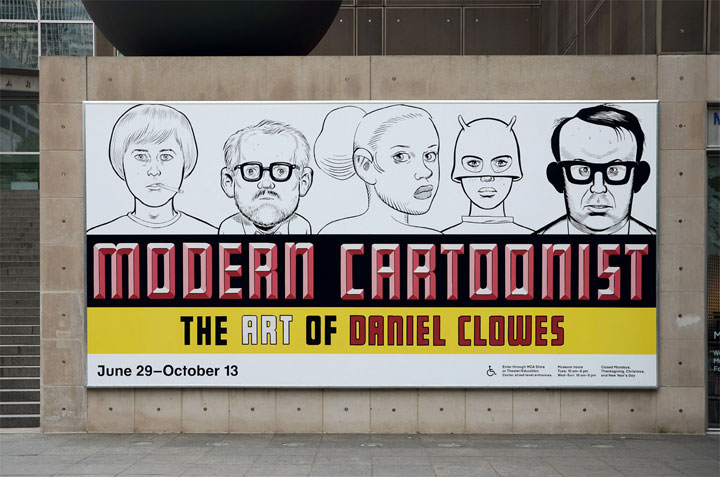
Modern Cartoonist: The Art of Daniel Clowes at MCA Chicago
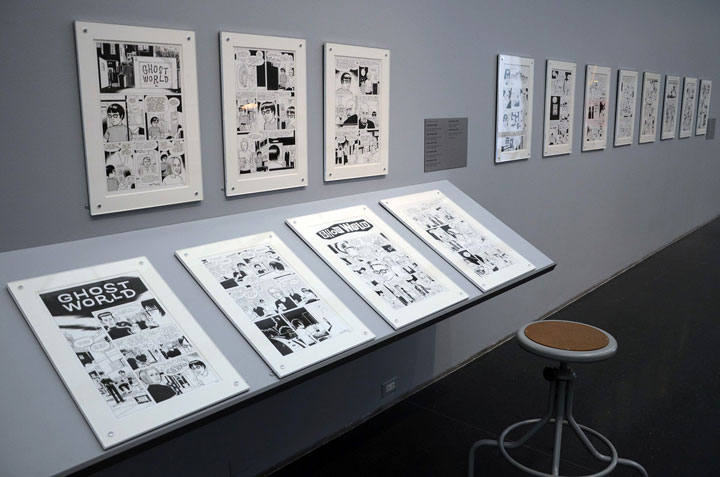
Currently on view at the Museum of Contemporary Art Chicago is Modern Cartoonist: The Art of Daniel Clowes, the very first museum retrospective to survey the work of the acclaimed comic book artist and graphic novelist. The Chicago-born, Oakland-based Clowes is responsible for such cult classics as Like a Velvet Glove Cast in Iron (1993), Ghost World (1997, and its 2001 film adaptation of the same name), David Boring (2000), and The Death-Ray (2011). An expanded version of a 2012 exhibition at the Oakland Museum of California, Modern Cartoonist presents more than 125 original illustrations and artifacts within thoughtfully designed exhibition spaces.
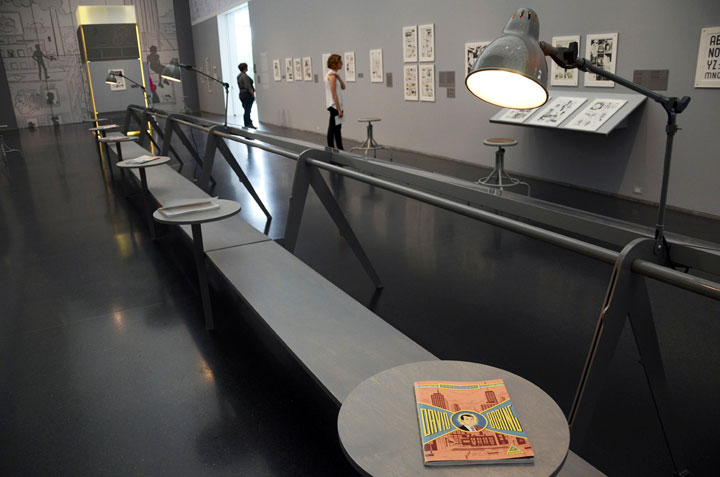
Installation shot of Modern Cartoonist: The Art of Daniel Clowes at The Museum of Contemporary Art, Chicago, August 2013. Image courtesy of Berny Tan.
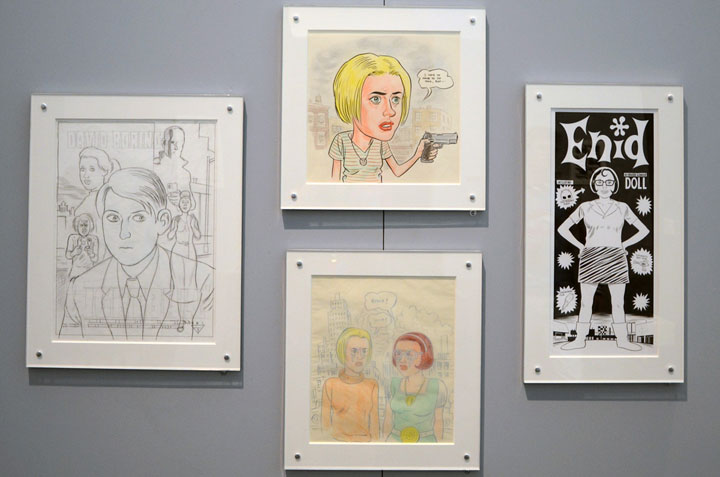
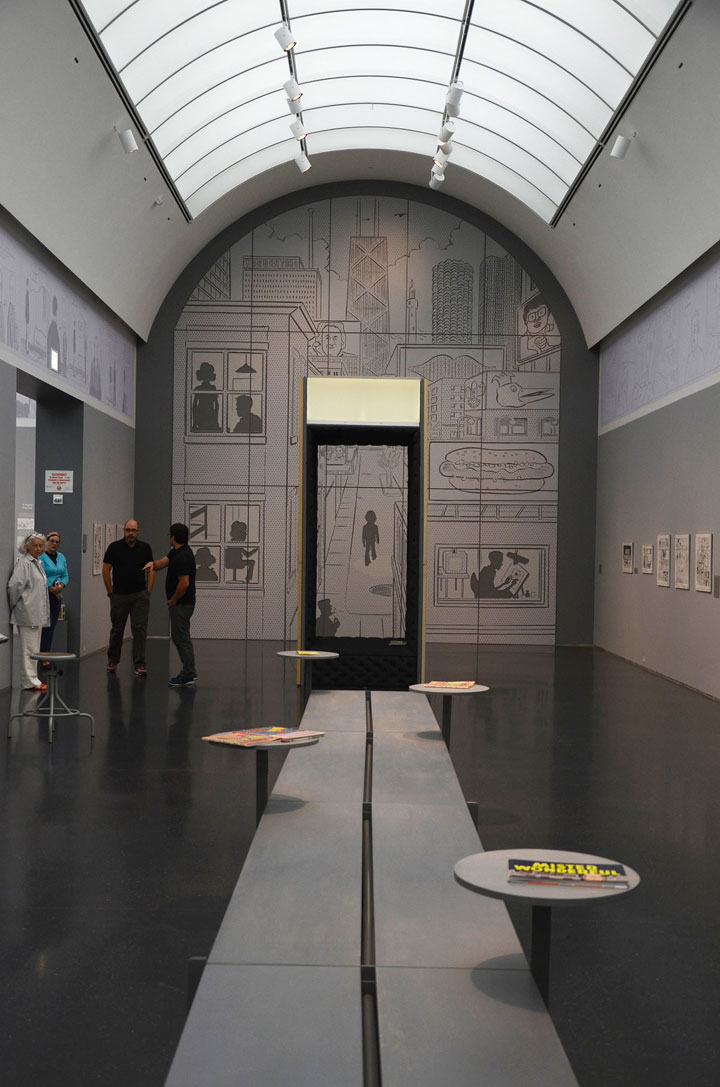
From deftly executed ink and Zipatone drawings to rich, saturated gouache paintings and rough graphite sketches, the works on display well validate Clowes’s abilities as a draftsman. One can imagine an excited Clowes fan devouring the pages upon pages of his illustrations on view in their bare, black-and-white form. For the rest of us, there is something to appreciate in both the meticulous lettering and literary content of each speech bubble. Single-page excerpts from Clowes’s most well-known comics are more than enough to bait the uninitiated into spending time with their bleak and often twisted narratives. In addition, two 20-foot-high monochromatic murals, featuring silhouettes of Clowes’s characters situated within urban Chicago, are pleasant, unexpected bookends to the exhibition’s drawings and publications.
Installation shot of Modern Cartoonist: The Art of Daniel Clowes at The Museum of Contemporary Art, Chicago, August 2013. Image courtesy of Berny Tan.
The exhibition is a joy to experience due not only to the immersive nature of Clowes’s work, but also to the exhibition design of Nicholas de Monchaux, who created a comfortable environment within which illustrations could be appreciated and comics perused. It would have been easy for de Monchaux to succumb to the seductively bright color palette of Clowes’s gouache paintings, or the muted yet diverse tones of his graphic novels. Instead, the designer opts for subtle shades of calming grays for the walls and fixtures. Ample seating is provided in the form of benches (lamps and tables included) and intimate spaces with upholstered seating where one might sit for hours on end reading Clowes’s graphic novels from cover to cover.
Daniel Clowes, Eightball 18
(cover), 1997. Gouache on white board, 24 3/4 x 22 1/2 x 1/2 inches.
Collection of Daniel Clowes. Image courtesy of the artist and Oakland
Museum of California.
Six decades after the inception of pop art and accompanying discussions of high-art-versus-low-art, today any debate about whether Clowes’s work belongs in a fine art museum should be rendered moot. However, questions regarding if and how we should compare Clowes and his peers to such artists as Roy Lichtenstein still remain, since we can expect both to continue inhabiting museums. Curator of the exhibition Susan Miller has commented on the similarities between Clowes’s style and the flatness of paintings by Alex Katz, as if to legitimize Clowes and the exhibition; the framing and display of Clowes’s illustrations lend a certain fine art regality to his oeuvre.
The issue here goes beyond the tired back-and-forth about whether a cartoonist should be viewed as a ‘fine artist.’ The museum setting inevitably transforms the way that someone might otherwise relate to comics and graphic novels, which require much more time than today’s average museum-goer would accord to an artwork. How does one relate to material that is as much literary as it is visual within an art exhibition? Is the viewer willing to spend hours—in an exhibition space designed with that in mind—not just admiring Clowes’s inking technique, but also the dark and dysfunctional narratives that jar with his deceptively simple aesthetic? How does the art museum do justice to the works’ literary aspects in addition to their aesthetic ones?
Installation shot of Modern Cartoonist: The Art of Daniel Clowes at The Museum of Contemporary Art, Chicago, August 2013. Image courtesy of Berny Tan.
An exhibition such as Modern Cartoonist, intentionally or not, raises questions about the role of the museum in today’s world and its responsibilities in terms of education, experimentation, and even entertainment. It provides a refreshingly accessible and engaging experience to an audience with a diverse set of approaches, creating conditions that challenge both museum-goers and comics enthusiasts alike to consider Clowes’s work in a new context.
–Berny Tan, Communications Intern
Modern Cartoonist: The Art of Daniel Clowes runs through October 13 at the Museum of Contemporary Art Chicago (220 East Chicago Avenue, Chicago, IL 60611).
sexta-feira, 30 de agosto de 2013
How to Draw a Human Eye on 5 steps
Edited by Maxwell K, Maluniu, ElizabethD, BR and 7 others
Edit Steps
- 1Draw one big circular ball to make out the eye. This will form the eye socket. The top of this circle is where the eyebrow is and at the bottom is where the cheek bone sits. Add the lines.
- 2Draw the eyeball floating in the centre of the socket.
- 3You then need to work on the shape of the eye. Eyes are almond shaped, so bear this in mind as you sketch them. As a rule of thumb, the distance between the two eyes is the width of another eye.
- 4Inside the iris, the color inside the center of the eye, draw the pupil which is the darkest bit of the eye. Fill most of it in black and leave a little white. With your pencil flat, use a bit of shading for the base.
- 5Next, draw the top of the eyelid over the top of the almond. Add any detail you like, like eyelashes, etc.,
sexta-feira, 23 de agosto de 2013
Draw famous faces
So you’re a budding artist, but you need a little help to get going? The good news is that we’re here to help you get your celeb drawing or sketched masterpiece done in no time.
Whether you want to know how to draw Justin Bieber, how to draw One Direction, how to draw Lady Gaga, how to draw Nicki Minaj, how to draw Rihanna or how to draw a number of other famous faces, we’re gonna help you!
Now you can draw quickly and accurately
We’ve done two important things to help you draw your favorite celebrities QUICKLY and ACCURATELY:- Grid Method: All images come with a ready-made grid to save you time and help you draw your portrait realistically.
- Gray-scale Images to Help You Shade: All the photos on this site have been converted to black and white to make it easy for you to match the grays tones when you shade in your drawing.
segunda-feira, 12 de agosto de 2013
History of Drawing: the textbook
History of Drawing is a textbook and reference book available free to anyone who loves drawings.
Use the navigator at the top of the page to jump between chapters.
Thomas Buser earned his doctorate in Art History from NYU’s Institute of Fine Arts in 1974. He taught courses in Baroque Art and the course History of Prints and Drawings at the University of Louisville until his retirement in 2005. He has published Religious Art in the Nineteenth Century in Europe and America (two volumes, 2002) and the textbook Experiencing Art Around Us (second edition, 2006).
As far as possible, the drawings have been reproduced throughout the book in the same scale: halfway across the page equals 20 centimeters (about eight inches), all the way across the page equals 40 centimeters (a little less than sixteen inches). Needless to say, drawings that are wider than 40 centimeters are out of scale.
Use the navigator at the top of the page to jump between chapters.
Thomas Buser earned his doctorate in Art History from NYU’s Institute of Fine Arts in 1974. He taught courses in Baroque Art and the course History of Prints and Drawings at the University of Louisville until his retirement in 2005. He has published Religious Art in the Nineteenth Century in Europe and America (two volumes, 2002) and the textbook Experiencing Art Around Us (second edition, 2006).
As far as possible, the drawings have been reproduced throughout the book in the same scale: halfway across the page equals 20 centimeters (about eight inches), all the way across the page equals 40 centimeters (a little less than sixteen inches). Needless to say, drawings that are wider than 40 centimeters are out of scale.
segunda-feira, 15 de julho de 2013
Artists call weekend gathering the 'Drawing Frenzy,' invite parents to bring artistic children.
Parents that have kids with artistic flair might want to eat at the Crossroads Coffee House after 11 a.m. some Saturday or Sunday. Like every weekend for several years, a local group of professional artists will be there. They call it the "Drawing Frenzy," a come one, come all draw-a-thon.
All artists, from children to adults are welcome. They can ask questions, or talk about their favorite animated show, comic book or whatever inspires their art. But there are a couple of rules. Keep the conversation light … no politics. Just stop in, pull up a sandwich and a pen, tablet, sculpture -- you get the idea.
One creator of the Drawing Frenzy and illustration mentor is Mike Sullivan, a talented local comic-book artist.
"It’s just a very nurturing environment for creativity and people are drawn to it… and we just feed off that,” Sullivan said.
Another local painter and comic artist that meets regularly at the coffee house is Darryl Woods. He tells young artists to draw something every day but make sure it’s something new: Don’t keep rehashing the same old thing.
Woods said he has seen the Drawing Frenzy bring the shy strokes of a budding artist to full bloom. As he tells the tale, just last week a young, shy visitor to the coffee house came in to share a few sketches. She introduced herself as the daughter of a face painter.
“She had very low confidence in her ability to draw,” Woods said. “She is an extraordinary artist.”
The gang at the Drawing Frenzy is certainly about encouragement, and that is the message they pass along to each and every person who has the courage to pull up a chair and share their doodles.
The Drawing Frenzy meets at the Crossroads Coffee House, 310 Southwest Blvd., Kansas City, Mo., 64108. The artists meet from 11 a.m. – 3 p.m. every Saturday and Sunday.
The artists include: Mike Sullivan, Ed Lavallee, Joe Hall, Damont Jordan, Beejay Hawn, Greg Gildersleeve, Taylor Castro, Buck Sommerkamp, Rob Nix and Mike Keener.
All artists, from children to adults are welcome. They can ask questions, or talk about their favorite animated show, comic book or whatever inspires their art. But there are a couple of rules. Keep the conversation light … no politics. Just stop in, pull up a sandwich and a pen, tablet, sculpture -- you get the idea.
One creator of the Drawing Frenzy and illustration mentor is Mike Sullivan, a talented local comic-book artist.
"It’s just a very nurturing environment for creativity and people are drawn to it… and we just feed off that,” Sullivan said.
Another local painter and comic artist that meets regularly at the coffee house is Darryl Woods. He tells young artists to draw something every day but make sure it’s something new: Don’t keep rehashing the same old thing.
Woods said he has seen the Drawing Frenzy bring the shy strokes of a budding artist to full bloom. As he tells the tale, just last week a young, shy visitor to the coffee house came in to share a few sketches. She introduced herself as the daughter of a face painter.
“She had very low confidence in her ability to draw,” Woods said. “She is an extraordinary artist.”
The gang at the Drawing Frenzy is certainly about encouragement, and that is the message they pass along to each and every person who has the courage to pull up a chair and share their doodles.
The Drawing Frenzy meets at the Crossroads Coffee House, 310 Southwest Blvd., Kansas City, Mo., 64108. The artists meet from 11 a.m. – 3 p.m. every Saturday and Sunday.
The artists include: Mike Sullivan, Ed Lavallee, Joe Hall, Damont Jordan, Beejay Hawn, Greg Gildersleeve, Taylor Castro, Buck Sommerkamp, Rob Nix and Mike Keener.
terça-feira, 25 de junho de 2013
Political cartoonists invading Salt Lake City
Don’t tell political cartoonist Matt Wuerker that he works in a dying business or that the traditional print form of lampooning is an endangered species.
"There is a shorter and shorter attention span in readership," said the president of the Association of American Editorial Cartoonists. "Nothing addresses that strange problem more than a good political cartoon. The old saw that a picture is worth a thousand words speaks to the unique power of cartoons to communicate complex ideas...It takes less time to get a cartoon than to read 140 characters [on Twitter]."
Wuerker and more than 80 of the nation’s top cartoonists will be in Salt Lake City this week for the association’s annual convention. Those participating include Pulitzer Prize winners such as Wuerker from Politico, Steve Benson from The Arizona Republic and Patrick Oliphant from Universal Uclick Syndicate. The Salt Lake Tribune’s Pat Bagley also will be at the event that includes workshops, a cartoonist "death match" at The Tavernacle Bar and a Cartoons and Cocktails benefit and auction.
Several free workshops open to the public will examine issues such as the use of cartoons to satirize religion, a look at Thomas Nast, who is regarded as the father of modern political cartoons, and how political cartoons often kick-start controversy. (See schedule.)
"We are a strange bunch," said Wuerker. "We represent the full political spectrum with troglodytes on the right and bleeding hearts on the left. But what trumps political differences is respect for each other’s drawing and keeping an ancient and enduring craft alive."
Benson, a Brigham Young University graduate and grandson of former LDS Church President Ezra Taft Benson, said cartoonists look at the world differently.
"Cartoonists tend to see quirky things," he said. "It’s a working combination of being analytical on the current-events side mixed with a deep sense of curiosity about the world in the left side of the brain along with the little kid who never grew up and liked to draw funny pictures in class."
The Arizona Republic cartoonist said his art is about more than drawing. It is about illustrating an opinion on a political, social or current topic.
Though both he and Bagley have retired from the LDS Church, they met at BYU, where they worked as cartoonists for The Daily Universe. Their controversial takes on campus life often caused a stir.
The two published a collection of their Daily Universe cartoons and selected letters to the editor in 1979 in a book called I Am Appalled … (the title, Benson said, refers to the way many BYU students would start their letters to the editor about cartoons that offended them).
For example, Bagley’s first cartoon lampooned BYU’s fight over federal Title IX policies mandating coed housing. He portrayed National Guardsmen bringing in a young woman as a new roommate in previously all-male housing. Benson said students were not angered by the cartoon’s message but the fact that Bagley had placed a poster of bikini-clad Farrah Fawcett on the wall.
"An editorial cartoonist throws the first punch in a bar fight and then sits back and watches everyone fight," said Benson.
Jen Sorensen, a self-syndicated cartoonist whose primary clients are alternative weeklies such as Salt Lake City Weekly, is an example of that. She has found work on Web-oriented sites such as The Daily Kos, NPR.org and Politico. She has also found freelance work in longer-form commissioned comics.
"The print media still forms the foundation for my income, but there are a lot of other little avenues I am pursuing online."
Wuerker said the Internet allows cartoonists to experiment with new forms of the craft, including animation and interactive cartoons.
Benson put how his peers view the new technology in a different way.
"You have those whose job is to educate the cartooning coots, who are still happy with a camel-hair brush and who ask what’s this Photoshop stuff," he said. "The swamp might be being drained, but it’s still there. It’s a smaller pond, but it still has life in it."
"There is a shorter and shorter attention span in readership," said the president of the Association of American Editorial Cartoonists. "Nothing addresses that strange problem more than a good political cartoon. The old saw that a picture is worth a thousand words speaks to the unique power of cartoons to communicate complex ideas...It takes less time to get a cartoon than to read 140 characters [on Twitter]."
Wuerker and more than 80 of the nation’s top cartoonists will be in Salt Lake City this week for the association’s annual convention. Those participating include Pulitzer Prize winners such as Wuerker from Politico, Steve Benson from The Arizona Republic and Patrick Oliphant from Universal Uclick Syndicate. The Salt Lake Tribune’s Pat Bagley also will be at the event that includes workshops, a cartoonist "death match" at The Tavernacle Bar and a Cartoons and Cocktails benefit and auction.
Several free workshops open to the public will examine issues such as the use of cartoons to satirize religion, a look at Thomas Nast, who is regarded as the father of modern political cartoons, and how political cartoons often kick-start controversy. (See schedule.)
"We are a strange bunch," said Wuerker. "We represent the full political spectrum with troglodytes on the right and bleeding hearts on the left. But what trumps political differences is respect for each other’s drawing and keeping an ancient and enduring craft alive."
Benson, a Brigham Young University graduate and grandson of former LDS Church President Ezra Taft Benson, said cartoonists look at the world differently.
"Cartoonists tend to see quirky things," he said. "It’s a working combination of being analytical on the current-events side mixed with a deep sense of curiosity about the world in the left side of the brain along with the little kid who never grew up and liked to draw funny pictures in class."
The Arizona Republic cartoonist said his art is about more than drawing. It is about illustrating an opinion on a political, social or current topic.
Though both he and Bagley have retired from the LDS Church, they met at BYU, where they worked as cartoonists for The Daily Universe. Their controversial takes on campus life often caused a stir.
The two published a collection of their Daily Universe cartoons and selected letters to the editor in 1979 in a book called I Am Appalled … (the title, Benson said, refers to the way many BYU students would start their letters to the editor about cartoons that offended them).
For example, Bagley’s first cartoon lampooned BYU’s fight over federal Title IX policies mandating coed housing. He portrayed National Guardsmen bringing in a young woman as a new roommate in previously all-male housing. Benson said students were not angered by the cartoon’s message but the fact that Bagley had placed a poster of bikini-clad Farrah Fawcett on the wall.
"An editorial cartoonist throws the first punch in a bar fight and then sits back and watches everyone fight," said Benson.
Jen Sorensen, a self-syndicated cartoonist whose primary clients are alternative weeklies such as Salt Lake City Weekly, is an example of that. She has found work on Web-oriented sites such as The Daily Kos, NPR.org and Politico. She has also found freelance work in longer-form commissioned comics.
"The print media still forms the foundation for my income, but there are a lot of other little avenues I am pursuing online."
Wuerker said the Internet allows cartoonists to experiment with new forms of the craft, including animation and interactive cartoons.
Benson put how his peers view the new technology in a different way.
"You have those whose job is to educate the cartooning coots, who are still happy with a camel-hair brush and who ask what’s this Photoshop stuff," he said. "The swamp might be being drained, but it’s still there. It’s a smaller pond, but it still has life in it."
Assinar:
Postagens (Atom)